Getty is moving toward a more decentralized architecture, with permanent records on Arweave and verifiable projections on AO, supported by our own HyperBEAM node.
Our own node, verifiable state and permanent records for creator tools.
We have a major update to share: getty now operates its own HyperBEAM node, with a deeper AO and Arweave integration running in production.
Polls, raffles, achievements, selected preferences and stream history are part of this integration. The goal is to connect everyday creator tools with durable records and application state we can inspect and compare.
We also have a real production result to show: a poll created in getty, answered through chat and closed in production produced an AO projection with exactly the same payload as its PostgreSQL publication snapshot.
What each component contributes
Arweave provides permanent storage for intentionally published records, including selected results and stream archives.
AO provides the processes we use for state projections and lightweight archive references.
HyperBEAM evaluates process messages and exposes their state for inspection. Getty now operates its own node for this integration.
For creators and viewers, this connects to a familiar workflow: manage a poll, receive chat responses, display the outcome and retain its permanent result reference.
A real poll with a checked result
We tested the full workflow with a question about a future stream on AO. It was a small functional production test with one vote: Yes, 1; No, 0.
After the poll closed, we compared its publication with the confirmed source snapshot:
| Check | Result |
|---|---|
| Poll | Closed |
| PostgreSQL version | 8 |
| AO version | 8 |
| AO publication status | Published |
| Complete payload | Exact match |
| Payload SHA-256 | Exact match |
| Votes | Yes: 1 · No: 0 |
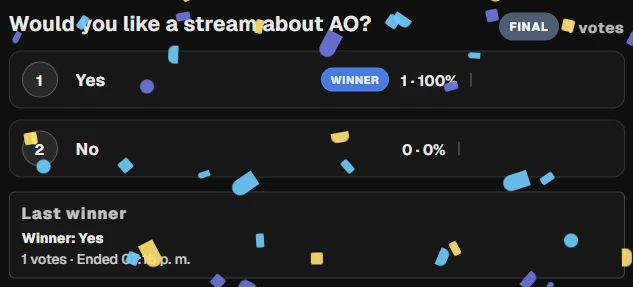
For that round, the AO projection matches the PostgreSQL publication snapshot byte for byte. The Arweave result reference was also present in the verified state.
View the result record on Arweave.
These checks apply to the specific poll in this test. The link lets readers inspect its record; matching a projection and its reference is distinct from independently validating every referenced file.
How it fits the modules
Polls and raffles publish versioned projections of confirmed state. Achievements and selected preferences have encrypted copies of eligible records. Stream history publishes manifests and samples to Arweave and registers their references in AO; the workflow checks the index and content before treating an archive as complete.
The architecture keeps clear responsibilities: PostgreSQL remains the primary application store, AO receives the projections, and Arweave holds the corresponding permanent records. Retrying a projection does not cast another vote or repeat a raffle draw.
Private copies are encrypted before publication. Their scope is explicit: credentials, wallet keys and private authentication records are excluded from these projections. Protecting the original keys remains essential because ciphertext and some metadata can remain publicly observable.
What this means for the community
This update connects everyday streaming features with outcomes that leave durable references and state whose publication can be checked.
It also gives us a concrete foundation for what comes next: a Getty-operated HyperBEAM node, modules connected to AO, records on Arweave and a successful production consistency check.
We are updating the public documentation to explain the architecture, the publication stages and what result verification means. We want the next features to build on a foundation the community can understand.
Thank you to the people building AO, HyperBEAM and Arweave, and to everyone testing getty and sharing feedback. We are continuing to bring these technologies into useful tools for creators.
What would you like getty to build next with AO and Arweave?